. . . . . . . . . . . . . . . . . . . . . . . . . . . . . . . . . . . . . . . . . . • Catholic End Time Prophecies- -• New Book: What Do We Know About Our Future: HEAVEN, HELL, PURGATORY by Stephen A. Foglein, MS. A fresh new space age look at these ancient mysteries. It's a must for those who value eternal life! When was the last time you heard about them? What about your children? More exciting than science fiction.
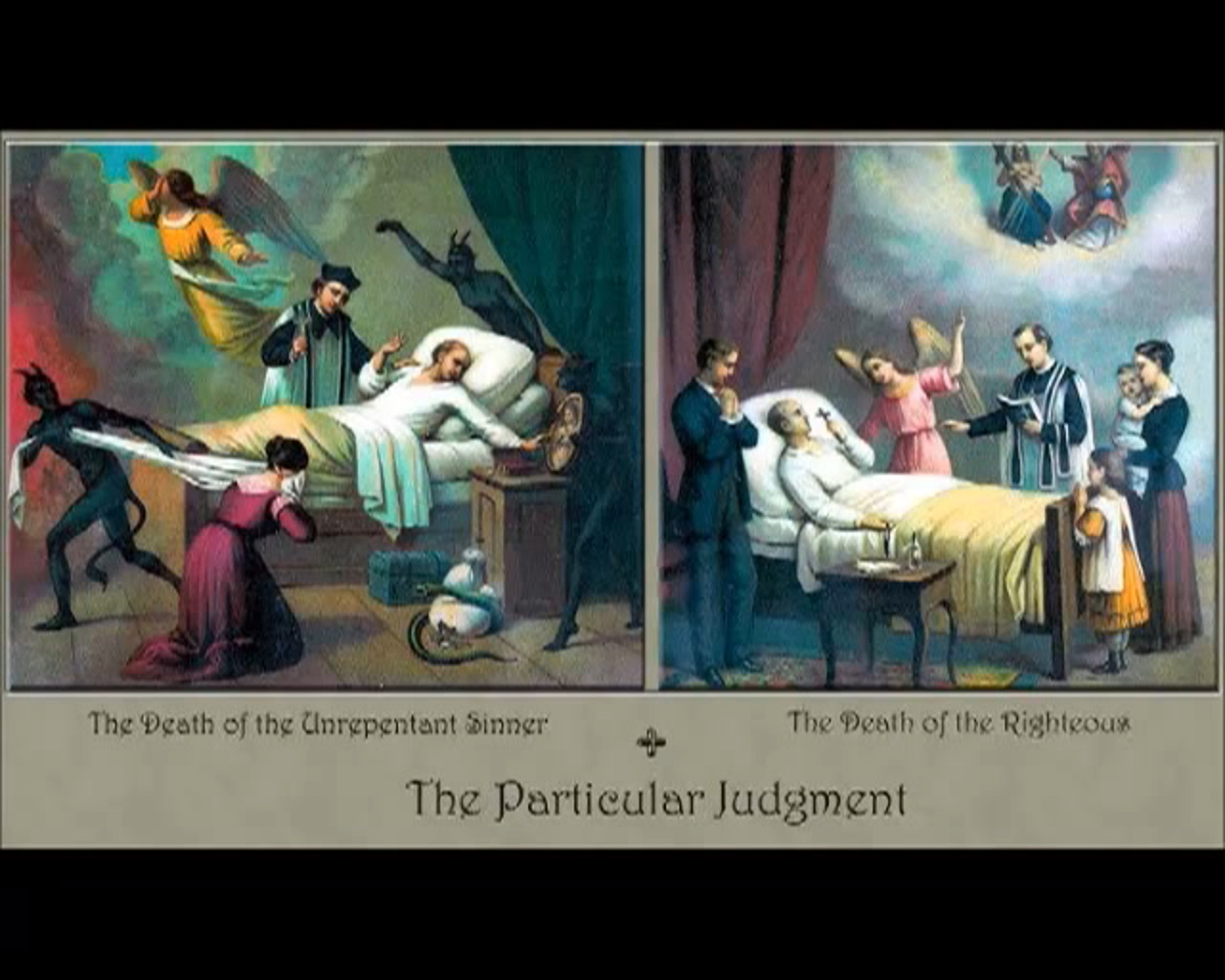
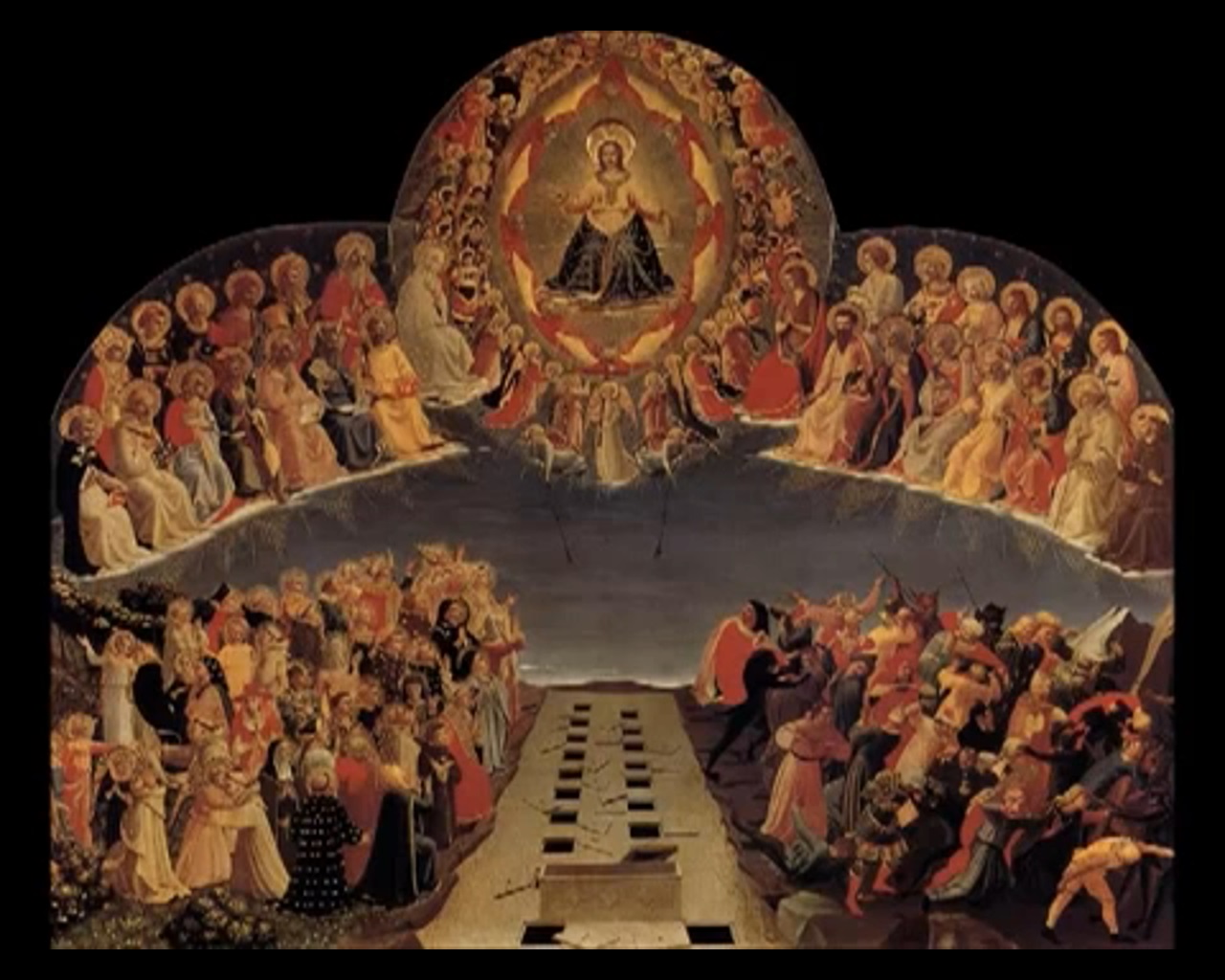
Death. Judgment. Heaven. Hell. ". . . It is appointed unto men once to die, and after this the judgment. . ." Hebrews 9:27
"For we must all appear before the judgment seat of Christ." -- 2 Cor. 5:10.
"The days are coming to a close and life is passing. . Death, judgment and eternity are drawing near." -- Padre Pio
He who loves God with all his heart does not fear death or punishment or judgment or hell, because perfect love assures access to God. (1 John 4:18)
It is no wonder that he who still delights in sin fears death and judgment.
It is good, however, that even if love does not as yet restrain you from evil, at least the fear of hell does. The man who casts aside the fear of God cannot continue long in goodness, but will quickly fall into the snares of the devil.
-- Imitation of Christ, Book 1, Ch. 24.
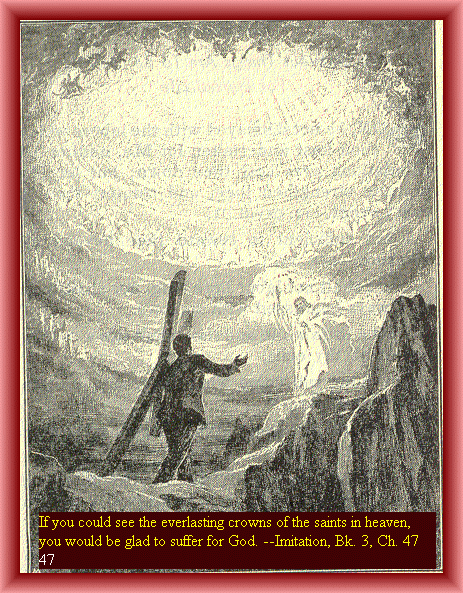
And if you pondered in your heart the future pains of hell or of purgatory, I believe you would willingly endure labor and trouble and would fear no hardship.
-- Imitation, Bk. 1, Ch. 21.
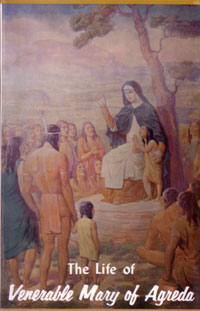
Among the absurd fallacies introduced by the demon into the world none is greater or more pernicious than the forgetfulness of the hour of death and of what is to happen at the court of the rigorous Judge. Consider, my daughter, that through this portal sin entered into the world; for the serpent sought to convince the first woman principally, that she would not die and need not think of that matter (Gen. 3, 4). Thus continually deceived, there are uncountable fools who live without thought of death, and who die forgetful of the unhappy lot that awaits them. In order that thou mayest not be seized by this human perversity, begin to convince thyself now that thou must die irrevocably. . . . . -- Mary of Agreda: Mystical City of God, Vol. 4.
Counsels of Abbot Evagrius from "Lives of the Desert Fathers." Book 3. On Cumpunction
Abba Evagrius said, "When you sit in your cell, retire into yourself and think of the day of your death. You will then realise how the body will decay. Think of its dissolution and mourn. Conceive a repulsion for the vanities of the world. Be self-effacing and take thought as to how you might always remain in this state of quiet, and you will be all right. Think of all those who are in hell. Picture to yourself the state of their souls, their bitter silence, their heart rending groans, their fearful struggles, their grief and longing, their unending tears without relief. Consider also what confusion engulfs the sinners, suffering as they do in the sight of Christ and in the presence of Angels and Archangels, and Powers and all mankind. Think of all their punishments, the eternal fire, the deathless worm, the darkness of Tartarus, and above all, the gnashing of teeth, the fears and the torments.
"Contrast that with the good things laid up for the righteous, confidence before God the Father and Christ his Son, in the presence of the Angels and Archangels and Powers, in the presence of the whole company of the kingdom of heaven, with its gifts of joy and peace.
"Keep the memory of both these alternatives with you, and groan over the judgment pronounced upon sinners. Weep, imagine how they grieve, and fear lest you fall into the same condemnation. But over the good things laid up for you, rejoice, exult, and be glad. Hasten to enjoy them, but keep the other place far from you. Never forget these things whether you are in your cell or elsewhere. Let the image of these things remain ever in your mind, for by this means you will at least rid your mind of evil and harmful thoughts."
Abba Elias said, "I fear three things, first, the hour of my death, secondly having to stand before God, thirdly the sentence which will be pronounced upon me."
Notice: Charles Reed is the pseudonym of John Henderson Stansberry, a former religious brother in the congregation of the Franciscan Minims in Mexico City. In the year 1978, (one year before the death of Maria Concepcion), a tragic incident happened in the congregation. Many years later John still felt guilty about it, and determined to write a report. Eventually the document turned into a short book, named "Mount Zion Revisited." The pseudonym Charles was used to protect the good reputation of all the persons involved.
Writings of Charles Reed also include translations and short anthologies that he made, and editorials of the magazine "Reflections from the Franciscan Minims" published in English in Mexico City from 1990 to 2005. The magazine had a circulation of about 300, in the United States, Canada, Europe, Asia and Africa.
"Mount Zion Revisited" was written as a roman a clef (novel with a key), in order to make known controversial topics, and to report inside information about scandal and abuse of power, without harming the good reputation of those involved, living and deceased.
“For the past 50 years, every major institution has been captured by the radical secular left. The media, Hollywood, TV, universities, public schools, theater, the arts, literature — they relentlessly promote the false gods of sexual hedonism and radical individualism. Conservatives have ceded the culture to the enemy. Tens of millions of unborn babies have been slaughtered; illegitimacy rates have soared; divorce has skyrocketed; pornography is rampant; drug use has exploded; sexually transmitted diseases such as AIDS have killed millions; birth control is a way of life; sex outside of wedlock has become the norm; countless children have been permanently damaged — their innocence lost forever — because of the proliferation of broken homes; and sodomy and homosexuality are celebrated openly. America has become the new Babylon.” – Jeffrey Kuhner, Washington Times
The fight has now come full force. What was once done in darkness is now celebrated in the light. Yet, where before we may have been blinded, God’s Unfathomable Mercy is opening the hearts, the minds and the eyes of people of Faith. Our Lady’s Clarion Call – the call once trumpeted at Quito, LaSalette, Fatima, Tre Fontane and Akita— is upon us:
LA CROSSE, Wisconsin, July 4, 2018 (LifeSiteNews) — National Rosary organizers from around the world are joining forces to create a new “Holy League.”
There have been a number of “Holy Leagues” in history, national allies coming together to protect Christendom from its political enemies. Now, inspired by the mass rosary prayer events of recent months, the organizers of the American “Rosary Coast to Coast” have invited Catholics around the world to join them in a worldwide 54 Day Novena beginning at 4 PM (Eastern Time) on August 15, the Feast of the Assumption of the Blessed Virgin Mary, and culminating in a rosary on October 7, the Feast of the Most Holy Rosary.
“The formation of the New Holy League of Nations declares a united front in the worldwide spiritual battle, defending the dignity of the human person–life, marriage, family, as well as religious liberty,” organizers of Rosary Coast to Coast stated in a press release on Tuesday.
Unlike the Holy Leagues of old, this army will not be using blades, arrows, or cannons. “This ‘declaration of war’ is ‘not against flesh and blood; but against principalities and power, against the rulers of the world of this darkness, against the spirits of wickedness in the high places.” (Ephesians 6:12),” Rosary Coast-to-Coast explained. “Together we are calling upon God, through the powerful intercession of Our Lady of the Rosary, to heal our countries and return them to Holiness.”
Every group that participates is asked to choose intentions specific to their nation.
• How to Pray the 54 Day Novena • People have asked over time about the Luminous Mysteries — this novena was given by Our Lady as noted above in 1884 and only allows for the Joyful, Sorrowful and Glorious Mysteries.
"The active study of the four last things and the deep consideration of them, is the thing that will keep you from sin.". .
--Sir Thomas More
The Four Last Things
A Treatise by Sir Thomas More
1522
Let us hear, then, what wholesome receipt this is. "Remember," saith this bill, "thy last things, and thou shalt never sin in this world." Here is first a short medicine containing only four herbs, common and well known, that is to wit, death, doom, pain, and joy.
This short medicine is of a marvelous force, able to keep us all our life from sin.
A serious theological treatise on the Four Last Things --but purposely written for the average reader. Calling on Scripture and Church tradition, Rev. Garrigou-Lagrange weaves a profoundly enlightening study of 32 considerations relative to man's final destiny.
Read Me or Rue It --How to help the souls in Purgatory (text file format)
To download a book, please right click on the link;
Choose the option to 'Save Link As' or 'Save Target As'; then choose the folder on your computer.
------------------------------------------------------
In the book of Second Chronicles it is written: Zedekiah was 21 years old when he began to reign, and reigned 11 years in Jerusalem. And he did that which was evil in the sight of the Lord his God, and humbled not himself before Jeremiah the prophet speaking from the mouth of the Lord. Moreover all the chief of the priests, and the people, transgressed very much after all the abominations of the heathen; and polluted the house of the Lord which he had hallowed in Jerusalem. And the Lord God of their fathers sent to them by his messengers, rising up betimes, and sending; because he had compassion on his people, and on his dwelling place. But they mocked the messengers of God, and despised his words, and misused his prophets, until the wrath of the Lord arose against his people, till there was no remedy.
Therefore he brought upon them the king of the Chaldees, who slew their young men with the sword in the house of their sanctuary, and had no compassion upon young man or maiden, old man, or him that stooped for age; he gave them all into his hand. And they burnt the house of God, and brake down the wall of Jerusalem, and burnt all the palaces thereof with fire, and destroyed all the goodly vessels thereof. And them that had escaped from the sword carried he away to Babylon; where they were servants to him and his sons until the reign of the kingdom of Persia; to fulfil the word of the Lord by the mouth of Jeremiah, until the land had enjoyed her sabbaths; for as long as she lay desolate she kept sabbath, to fulfill threescore and ten years. – (2 Chron. 36)
It is written: They mocked the messengers of God, and despised his words, and misused his prophets.
In our days God has sent, not a prophet, but the Queen of prophets, who predicted at Fatima what would happen to the world, if people did not pay attention to her requests.
A few paid attention to her words, but the majority did not. When the great chastisement comes and various nations are annihilated, it will become clear to everyone that these times were worse than the times of Sodom and the Flood. If more than half the population perishes in the great chastisement, it will be their own fault, for they had an opportunity of being saved, and they despised it. They mocked the messengers of God and despised his words; they will be cut down like grass.
Fret not thyself because of evildoers, neither be thou envious against the workers of iniquity. For they shall soon be cut down like the grass, and wither as the green herb. – Psalm 37:2
For the arms of the wicked shall be broken: but the Lord upholdeth the righteous. – Psalm 37:17
Because I have called and you refused. I have stretched out my hand and no one regarded. Because you disdained all my counsel, and would have none of my rebuke, I also will laugh at your calamity; I will mock when your terror comes…… because they hated knowledge and did not choose the fear of the Lord, they would have none of my counsel and despised my every rebuke. Therefore they shall eat the fruit of their own way, and be filled to the full with their own fancies. - Proverbs Ch. 1
Octavio Michelini (14 August 1906 - 15 October 1979) of Mirandola, Italy was an Italian Roman Catholic Priest, considered to be a mystic. In 1975 he began to publish books pertaining to his visions of Jesus and Mary. Attached are the six volumes. He wrote many things about the Priesthood, evils within the church, the world, and Vatican II.
In 1938, Our Lord spoke to a Capuchin nun, Sister Consolata, in Italy and told her: "Do you know why I do not allow you many vocal prayers? Because an act of love is more fruitful.... Do not waste time, because every act of love represents a soul saved.... The greatest gift of all that you can offer to me is a day full of love.... I have rights over you. You told me that you love me! For this reason I desire an endless 'Jesus, Mary, I love you. Save souls!'
"If a creature of good will loves me and will make of his life a single act of love, from waking up to falling asleep (of course, with his heart), I will do incredible things for that soul. I thirst for love.... I thirst for being loved by my creatures!
"Souls believe that an austere and penitent life is needed to come to me. Can you see how they misrepresent me? They picture me as fearsome, while I am just kind! How easily do they forget the precept that I have given to you: 'You will love the Lord your God with all your heart, with all your soul, etc.' Today, as yesterday, as tomorrow, I will ask My creatures for love--always and forever." -- (taken from "Jesus Appeals to the World," by Lorenzo Sales.)
For the world, our century is the most fantastic time in all the history of mankind. There is no end to the scientific miracles. Hearts and other organs are routinely changed, man sets foot on the moon and countless technical marvels make life easier than ever. Barriers, society's moral laws, are disappearing at a fast pace. What was considered morally taboo a few decades ago is now completely normal, making life more "fun" than ever before. For the world, this is a good time, and the best is yet to come. - - - Read More Here
HELL
The Dogma of Hell, Illustrated by Facts Taken from Profane and Sacred History
by
Rev. F.X. Schouppe, S.J.
Copyright 1883, by P.V. Hickey, and first published in 1883, by Hickey & Co., Barclay Street, New York.
The fear of the Lord is the beginning of wisdom. -- Proverbs 9:10 -- Psalm 111:10
Josefa Menendez: 1890 -- 1923. -- Her writings, especially The Way of Divine Love, are a manifestation of Christ's infinite love.
Love of the Sacred Heart. Revelations of St. Gertrude the Great. 5 min. -- Jesus would once more tell his ungrateful creatures how much He loves them, would press them to His Heart, remind them of all he has done for them, and again try to touch their hearts and to save them. Love must penetrate still more deeply, and enkindle its flames in the very depths of our hearts. The love of Jesus must transform us into Himself, even as the fire transforms iron into its own nature, that so He may offer to His heavenly Father souls -- victims in one holocaust with Himself.
Paradise is the glorious reign of Heaven; there it is where resides the great recompense, that the eye of man has not seen, nor his ear heard, nor his intellect ever suspected. It is the dwelling of eternal joy, of complete and eternal exultation. It is there where resounds the canticle of jubilee, and the sweet singing of the Alleluia. It is there where is forever heard the ineffable melody of the canticles and of the instruments, and where the feast of eternity is celebrated. It is there where all the saints praise God without fatigue for the ages of the ages. It is there where abound all riches and all delights. --- Venerable Louis Blosius
St. Paul wrote: "I rejoice in my sufferings for you, and fill up those things that are wanting of the passion of Christ, in my flesh, for his body, which is the church." (Colossians 1, 24). If the passion of Christ is more than sufficient to redeem everyone, then why can he speak of "filling up those things that are wanting of Christ's passion"? These articles explain why. Legion of Victim Souls --- Download PDF The Unceasing Act of Love -- Revealed to the Capuchin Nun, Sister Mary Consolata Albert Drexel and Victim Souls
Atonement Booklets Categories: 1. Atonement in General. 2. Josefa Menendez. 3. Maria Concepcion Zuniga . . . . . . . . . . . . . . . . . . . . .
Reflections from the Franciscan Minims. Old Issues (2001--2005) of the magazine of the Franciscan Minims in Mexico
"Wisdom renews all things, and through nations conveys herself into holy souls. She makes the friends of God and prophets." --- Wisdom 7:27
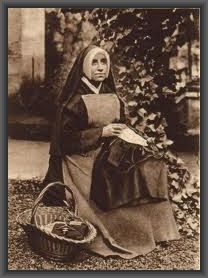
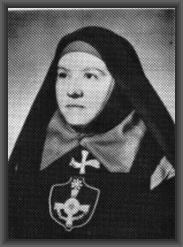
Maria Concepcion Zuniga Lopez was a Mexican religious who died in the odor of sanctity in 1979. Her most famous book is Legion of Victim Souls.(Imprimatur, 1966). Christ Our Lord is seeking a legion of victims, in order to save sinners from perdition. Her other works are:
My Best Book. A short autobiography.
Laments of Jesus, Victim. Six short meditations.
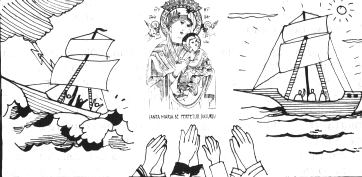
Warnings and Voices from Beyond the Grave. An account of how her sister, Esther Zuniga, asked help from purgatory. Prayer books: Penitential Rosary. The value of praying with one's arms in the form of a cross. Novena to Our Lady of Perpetual Help
"Ask not who is speaking, but mark what is said." - Imitation, Bk. 1, Ch. 5.
Address questions to: atonementwork@aol.com --
The purpose of this page, is to make known literature about atonement, reparation and oblation, by means of short booklets, taken from the writings of Josefa Menendez, Thomas a Kempis, and Madre Concepcion Zuniga. These writings are in the public domain. They may be copied, reproduced, distributed, spread, propagated, and made individually available, by anyone.
"And be not drunk with wine, wherein is excess; but be filled with the Spirit; speaking to yourselves in psalms and hymns and spiritual songs, singing and making melody in your heart to the Lord; giving thanks always for all things unto God and the Father in the name of our Lord Jesus Christ."
Notice and Disclaimer. The purpose of this webpage is to make available short booklets (electronic and hard copy) about atonement, reparation and victimhood, written by Catholic authors in general, and with emphasis on the writings of Josefa Menendez and Maria Concepcion Zuniga Lopez. All writings on this page are in the public domain and may be copied, reproduced and distributed by anyone. All writings in the booklets have been approved by the Catholic Church (with an Imprimatur), with the exception of some writings of Madre Concepcion Zuniga. (Her writing Legion of Victim Souls was granted an Imprimatur in 1966.) In conformity with the decrees of Pope Urban VIII, we have no intention of anticipating the judgment of the Apostolic See and of the Church, on revelations reported by us and not yet recognized. We submit to, and accept, its final decision without reservation. Disclaimer. This website is not affiliated with any organization. The group known as "legion of victim souls" is not an organization.
Send comments or questions to: atonementwork@aol.com
A free prayer card may be obtained by writing to this address.
May the Virgin of Perpetual Help be loved, praised, invoked and eternally blessed! May She be my hope, my love, my Mother, my refuge and my life. Amen.
Psalm 116
O praise the Lord, all ye nations: praise him, all ye people.
For his mercy is confirmed upon us: and the truth of the Lord remaineth for ever.
Glory be to the Father, and to the Son, and to the Holy Ghost.
As it was in the beginning, is now and for ever, world without end. Amen.
"Thy testimonies are justice for ever: give me understanding, and I shall live." "Thy justifications I will never forget: for by them thou hast given me life." -- Ps. 118, 144, 93
Visits since June 25, 2012 (red dots show where visitors are from) * * * * * * *
"I wish to set forth my faith as particularly answering this double spiritual need, the need for that mixture of the familiar and the unfamiliar which Christendom has righly named romance. For the very word 'romance' has in it the mystery and ancient meaning of Rome. Any one setting out to dispute anything ought always to begin by saying what he does not dispute. Beyond stating what he proposes to prove, he should always state what he does not propose to prove. The thing I do not propose to prove, the thing I propose to take as common ground between myself and any average reader, is the desirability of an active and imaginative life, picturesque and full of a poetical curiosity, as life such as western man at any rate always seems to have desired. If a man says that extinction is better than existence, or blank existence better than variety and adventure, then he is not one of the ordinary people to whom I am talking. If a man prefers nothing, I can give him nothing. But nearly all people I have ever met in this western society in which I live would agree to the general proposition that we need this life of practical romance; the combination of something that is strange with something that is secure. We need so to view the world as to combine an idea of wonder and an idea of welcome. We need to be happy in this wonderland without once being merely comfortable. It is this achievement of my creed that I shall chiefly pursue in these pages."

--- G.K. Chesterton, "Orthodoxy," Ch. 1
"Who is this guy and why haven't I heard of him?"
by Dale Ahlquist
I've heard the question more than once. It is asked by people who have just started to discover G.K. Chesterton. They have begun reading a Chesterton book, or perhaps have seen an issue of Gilbert! Magazine, or maybe they've only encountered a series of pithy quotations that marvelously articulate some forgotten bit of common sense. They ask the question with a mixture of wonder, gratitude and . . . resentment. They are amazed by what they have discovered. They are thankful to have discovered it. And they are almost angry that it has taken so long for them to make the discovery.
"Who is this guy. . .?"
Gilbert Keith Chesterton (1874-1936) cannot be summed up in one sentence. Nor in one paragraph. In fact, in spite of the fine biographies that have been written of him, he has never been captured between the covers of one book. But rather than waiting to separate the goats from the sheep, let's just come right out and say it: G.K. Chesterton was the best writer of the 20th century. He said something about everything and he said it better than anybody else. But he was no mere wordsmith. He was very good at expressing himself, but more importantly, he had something very good to express. The reason he was the greatest writer of the 20th century was because he was also the greatest thinker of the 20th century.
Born in London, Chesterton was educated at St. Paul's, but never went to college. He went to art school. In 1900, he was asked to contribute a few magazine articles on art criticism, and went on to become one of the most prolific writers of all time. He wrote a hundred books, contributions to 200 more, hundreds of poems, including the epic Ballad of the White Horse, five plays, five novels, and some two hundred short stories, including a popular series featuring the priest-detective, Father Brown. In spite of his literary accomplishments, he considered himself primarily a journalist. He wrote over 4000 newspaper essays, including 30 years worth of weekly columns for the Illustrated London News, and 13 years of weekly columns for the Daily News. He also edited his own newspaper, G.K.'s Weekly. (To put it into perspective, four thousand essays is the equivalent of writing an essay a day, every day, for 11 years. If you're not impressed, try it some time. But they have to be good essays - all of them -- as funny as they are serious, and as readable and rewarding a century after you've written them.)
The First Christian Revival -- "Early African Christianity produced a revival movement, the first Christian revival movement we know about.
Large numbers of men and women, seeking radical discipleship, came to the desert.
The desert became a city." [from talk given by Dr. Andrew Walls, 2003, Dallas Theological Seminary]
Our Lady. Sept. 20, 1986
“My children! Make sure that the great grace of the life offering will reach the souls who suffer greatly in body or in soul. It must reach the incurably sick, the physically handicapped, and the bedridden, so that their suffering will not be in vain! This suffering can become a fund of gold for all humanity, as well as for yourselves, because in your hearts and souls you will receive peace, strength, relief, and satisfaction, if you realize that patient acceptance of your sufferings will bring you great happiness in heaven!”
The seer: I obeyed this request of Our Lady, and I communicated this request to suffering souls. I can say from my own experience that their suffering was greatly lessened, when they accepted the graces that accompanied their life offering.- - Read More Here
Perpetual Adoration of the Blessed Sacrament --- (live image) Imitation of Christ, by Thomas a Kempis * * * "With respect to the life of perfection, it is just as you have grasped it this morning. Let people be guided by the book written by my very beloved son, Thomas a Kempis. He entitled his writings 'The Imitation of Christ,' by an order that I gave him, because he wrote these marvelous pages by the light of my spirit." -- Our Lord to Madre Concepcion: Nov. 14, 1973
Saints' Books -- holy books and extracts for the soul. This site has the Revelations of St. Gertrude in PDF format, to be downloaded free.
How Our Actions Can Be Acceptable
On one occasion during Lent, St. Gertrude asked our Lord how our actions may be acceptable. He replied:
"They would be so, if your fasts, vigils, and regular discipline were performed in memory of My Passion, and were offered to Me in union with the mortification of My senses which I have practiced during My Passion."
"Ah!" exclaimed Gertrude, "teach me, O best of teachers, how to perform even one action perfectly in memory of Thy passion." Our Lord replied: "When you are praying, extend your arms to represent the manner in which I extended Mine to God My Father in My Passion; and do this for the salvation of every member of the Church, in union with the love with which I stretched out My arms upon the cross." "If I do this," she replied, "I must hide myself in a corner, for it is far from being customary." Our Lord replied: "If any one prays thus with his hands extended, without fear of contradiction, he pays Me the same honour as one would do, who solemnly enthroned a king."
--- Revelations of St. Gertrude, Book 4. Ch. 13.
What is most pleasing to Jesus? --- One thing is particularly remarkable in the life of St. Gertrude, the like of which cannot be found in the life of any other saint: it is the extraordinary promises made to her by our Savior in favor of those who venerate her. The Hail Mary. 5 min. -- St. Jerome tells us that "the truths contained in the Hail Mary are so sublime, so wonderful, that no man or angel could fully understand them."
"We most humbly beseech Thee Almighty God, to command that these offerings be borne by the hands of Thy holy Angel to Thine altar on high in the sight of Thy Divine Majesty, that as many of us as at this altar shall partake of and receive the most holy Body and Blood of Thy Son, may be filled with every heavenly blessing and grace. Through the same Christ our Lord. Amen." -Supplices te Rogamus, from the Canon of the Mass (1962)
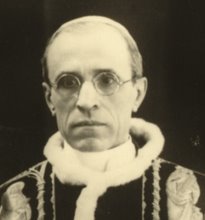
Pope Pius XII: "I hear all around me innovators who want to dismantle the Holy Chapel, destroy the universal flame of the Church, throw away her ornaments, give her a remorse of her historical past. Well my dear friend, I have the conviction that the Church of Peter must assume her past or she will dig her own grave."
Disclaimer. We do not necessarily agree with or support opinions expressed on other websites.
 Catholic End Time Prophecies- -• New Book: What Do We Know About Our Future: HEAVEN, HELL, PURGATORY by Stephen A. Foglein, MS. A fresh new space age look at these ancient mysteries. It's a must for those who value eternal life! When was the last time you heard about them? What about your children? More exciting than science fiction.

 •
• 

 ESPAÑOL: ♦